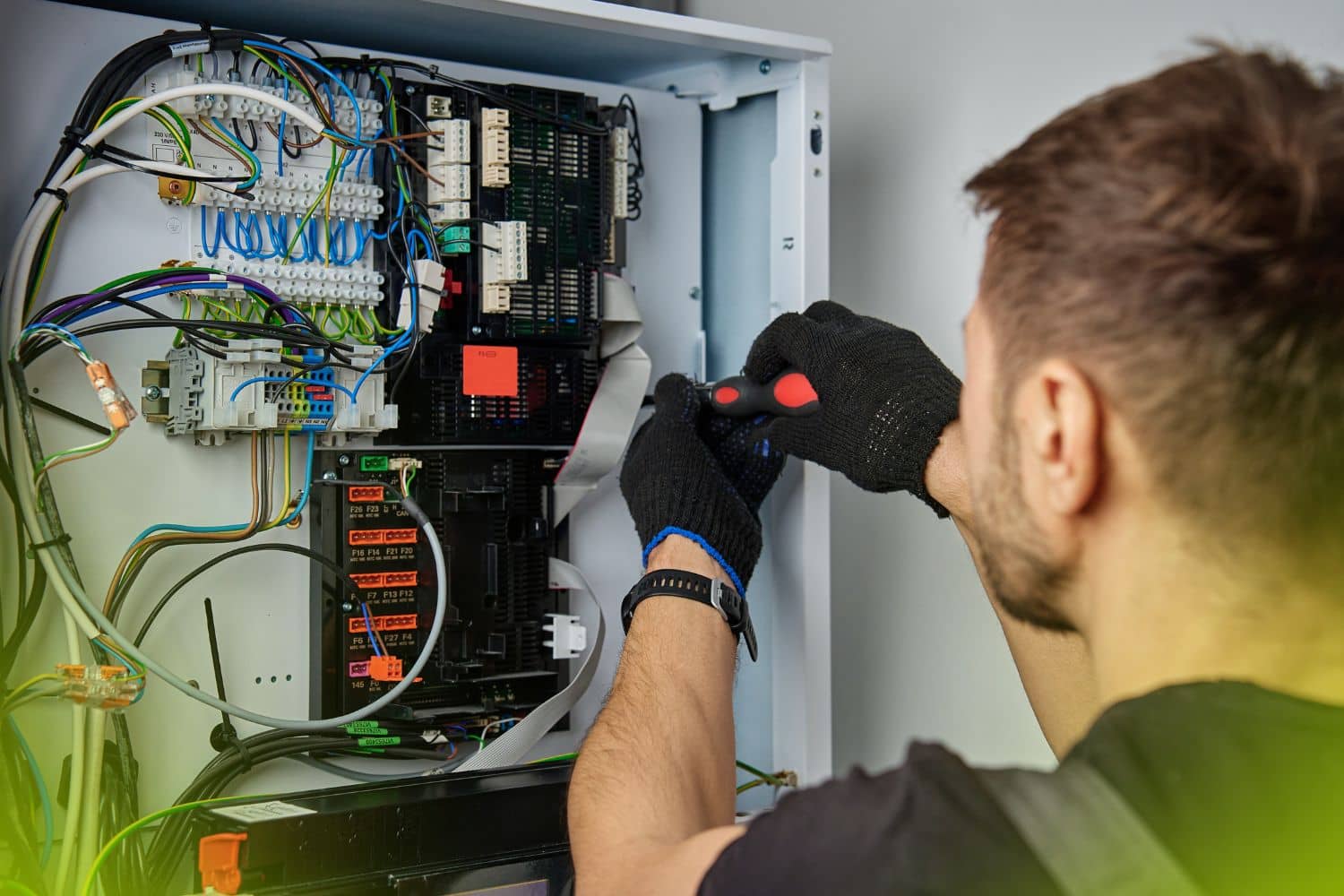
A home inspector examines the electrical panel on every inspection, and what they find there often changes the outcome of a sale.
From double-tapped breakers to outdated Federal Pacific panels, certain defects come up on reports again and again.
If you are buying or selling in the Greater Philadelphia area, this guide covers the most common electrical panel defects, what each one means, and how serious each finding actually is.
What Does a Home Inspector Look for in an Electrical Panel?
A home inspector evaluates the service panel for safety hazards, code violations, and conditions that could lead to fire or electric shock. This includes the panel brand, breaker labels, wire conditions, grounding and bonding, and the overall condition of the panel interior.
At L&L Home Inspections, inspections follow InterNACHI’s standards for electrical panelboard inspections, which outline the specific items every certified inspector is trained to check, from the main disconnect to individual breaker sizing.
Most inspectors will remove the dead front (the panel cover) to examine the interior directly. Removing the dead front is considered best practice for a thorough inspection.
With the cover off, the inspector can see the wiring, breakers, bus bars, and the condition of the panel interior.
One thing to know: home inspectors issue reports describing what they observed. They do not issue “pass” or “fail” results. Only a municipal electrical inspection, required for permitted work, uses formal pass/fail language.
Double-Tapped Breakers
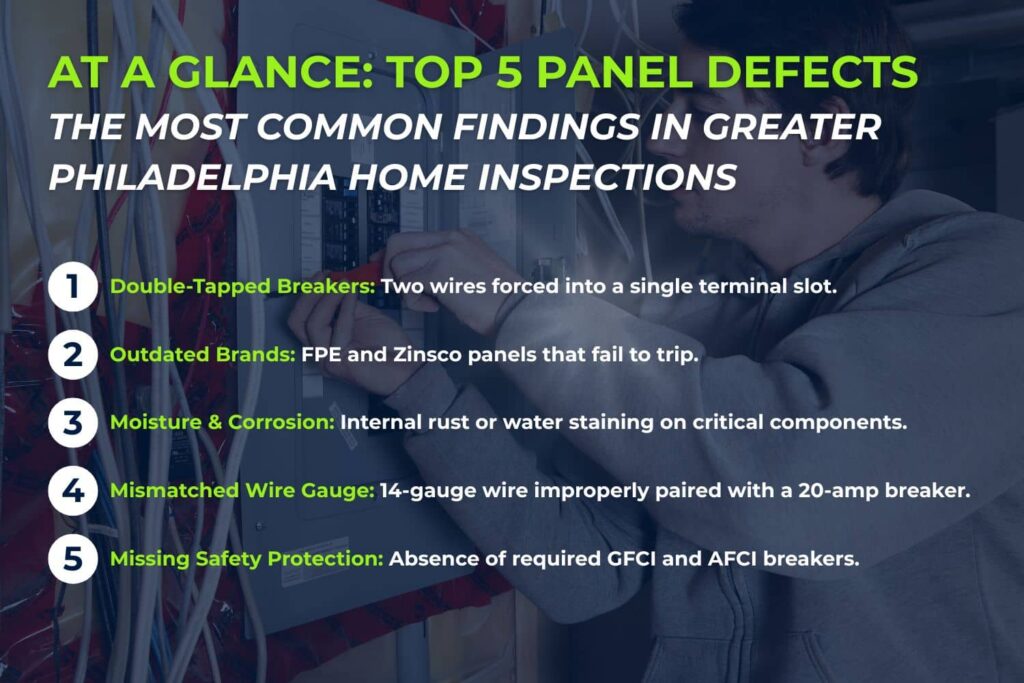
A double-tapped breaker has two wires connected to a single breaker terminal. This is one of the most common findings on electrical inspection reports, and it calls for a bit of nuance.
Most breakers are designed to accept only one wire. When two wires share a terminal, you can get loose connections, overheating, and arcing. That is a fire hazard.
However, not all double-taps are defects. Square D QO and Homeline series breakers are listed by UL for two conductors at certain wire gauges.
If your panel uses these breakers, some double taps may be intentional and code-compliant. Your inspector will note this in the report.
In all other panel brands, a double-tapped breaker should be corrected by a licensed electrician.
Federal Pacific Electric (FPE) and Zinsco Panels
If your home has a Federal Pacific Electric Stab-Lok panel or a Zinsco panel, your inspector will call it out on the report. Every time.
These panels were installed in millions of homes from the 1950s through the 1980s. Electricians and home inspectors have documented a consistent pattern of breaker failure in both brands.
When a breaker fails to trip during an overload, the circuit continues drawing current, and that overheating can start a fire.
One clarification: FPE and Zinsco panels were never formally recalled. The concern is based on industry consensus about failure rates, not a government recall notice.
This sometimes comes up in seller negotiations. The response is that the safety concern is documented and widely recognized in the industry, regardless of formal recall status.
Knowing which panels are flagged as non-insurable electrical panels before you go to closing helps you prepare for that negotiation. A full panel replacement in the Philadelphia suburbs generally runs $1,500 to $3,000, depending on service amperage and permit requirements.
Moisture, Rust, and Corrosion
Water and electrical panels do not mix. Inspectors look for rust staining, active moisture, corroded bus bars, or any sign that water has entered the panel enclosure.
Moisture inside a panel can come from a nearby water heater, a leaking pipe, condensation, or a panel mounted on an exterior wall without a proper vapor barrier.
Even small amounts of moisture cause corrosion over time. Corrosion on the neutral bus bar or on breaker contacts creates high-resistance connections, which leads to overheating and eventually arcing.
If an inspector notes moisture or corrosion, have a licensed electrician evaluate it before closing. The fix may be simple (resealing the panel, rerouting a pipe) or it may require component replacement.
Wiring Issues: Wrong Wire Gauge and Open Knockouts
Inspectors check that each breaker matches the correct wire gauge. The most common mismatch is 14-gauge wire on a 20-amp breaker.
Industry standards rate 14-gauge wire for 15 amps. A 20-amp breaker on that wire will not trip until current exceeds 20 amps, but the wire safely handles only 15.
The wire can overheat before the overcurrent protection activates.
Aluminum wiring is another flag. Homes built between 1965 and 1973 frequently used aluminum branch circuit wiring instead of copper.
Aluminum expands and contracts at a different rate than the devices it connects to, which can loosen connections over time.
This is not an automatic defect, but it does require compatible devices and periodic inspection.
Open knockouts are uncovered holes in the panel box that lack conduit. These leave live components exposed and allow debris or rodents into the enclosure.
Inspectors flag open knockouts as a direct shock hazard and a straightforward correction.
Missing GFCI and AFCI Protection
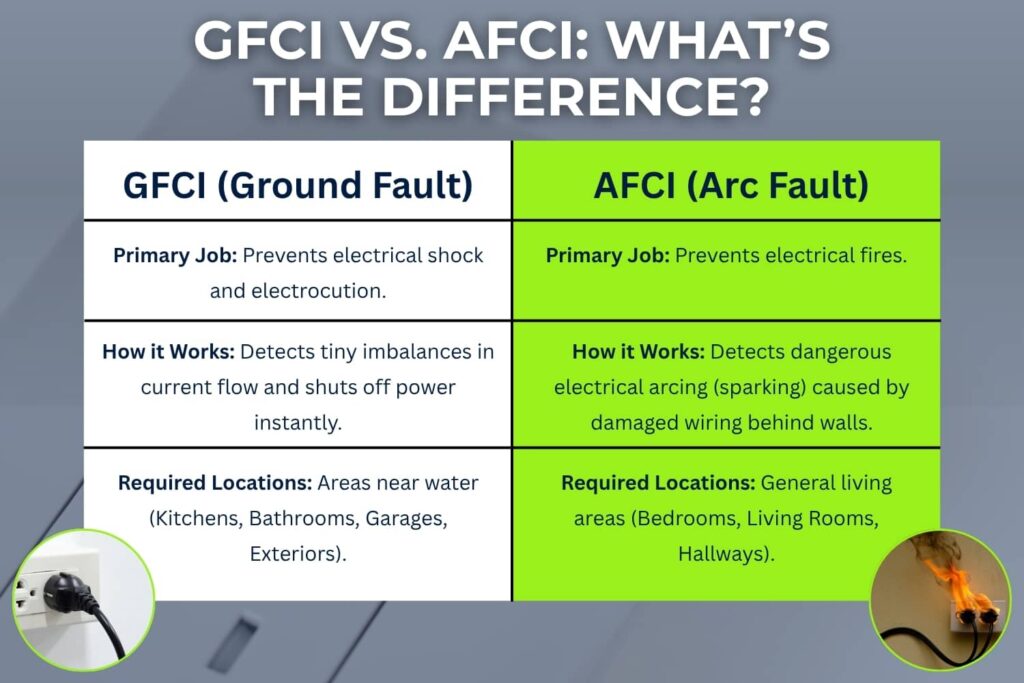
Current code requires Ground Fault Circuit Interrupter (GFCI) protection in kitchens, bathrooms, garages, outdoor outlets, unfinished basements, and areas near water.
GFCI devices detect current imbalances and shut off power in milliseconds, preventing electrocution.
Arc Fault Circuit Interrupter (AFCI) breakers detect the electrical signature of arcing, a leading cause of house fires.
The 2008 NEC required AFCI protection for bedroom circuits; later editions expanded the requirement to living rooms, hallways, and other areas.
Inspectors flag GFCI and AFCI deficiencies when the current code requires protection, and it is absent. Pennsylvania has its own AHJ (Authority Having Jurisdiction) framework, so local code adoption of specific NEC editions varies by municipality.
Your inspector will note what protection is absent; your electrician can confirm what your local code requires.
Just as dirty AC coils can affect a home inspection report in ways buyers do not expect, how those HVAC components affect an inspection is worth reviewing alongside the electrical findings.
Improper Panel Labeling
Homeowners should accurately label every circuit so anyone can safely operate the panel in an emergency. If someone leaves a breaker unlabeled or labels it incorrectly, a first responder, a plumber, or a family member cannot quickly shut off the right circuit.
Missing or inaccurate labels are a consistent inspection finding. They are among the least expensive items on a report to fix and among the easiest to overlook.
The correction is simple: trace each circuit, confirm what it feeds, and update the directory on the panel door. A licensed electrician can do this as part of a service call.
Related Questions to Explore
What other major safety and environmental hazards should be evaluated during a home inspection?
While a standard home inspection evaluates the physical structure and mechanical systems, it does not automatically include testing for invisible environmental hazards. Supplemental services like professional radon testing and comprehensive air quality and mold testing are highly recommended to ensure a property is safe to inhabit.
Are termite and pest inspections part of a standard home inspection?
General inspections look for visible structural damage, but they do not thoroughly cover wood-boring pests. Scheduling a dedicated wood-destroying insect inspection is the best way to uncover hidden termite activity, carpenter ants, or beetles before they cause costly structural issues.
How do buyers check the condition of underground waste and plumbing systems?
A standard home inspection only covers visible, interior plumbing lines. To evaluate the condition of underground pipes, buyers should schedule a sewer lateral inspection using a specialized camera or a comprehensive septic inspection if the home relies on an on-site wastewater treatment system.
When should a buyer request a specialized well and water test?
If a property relies on a private well rather than municipal water, standard visual checks cannot verify safety. Specialized well and water testing is crucial to check for harmful contaminants, bacteria, and heavy metals, while also verifying that the well pump produces an adequate water yield for daily use.
When to Call a Professional
If your inspection report flags any of the following, contact a licensed electrician before closing or before moving in:
- An FPE Stab-Lok or Zinsco panel
- Any moisture, rust, or corrosion inside the panel
- Wrong wire gauge for a breaker
- Aluminum wiring without compatible devices
- Missing AFCI protection on circuits that require it
- Open knockouts (more than one or two)
Buyers in Montgomery County and the surrounding Philadelphia suburbs commonly encounter these findings in homes built before 1980.
They are not automatic deal-breakers, but they require a written electrician estimate before you can negotiate effectively.
The L&L Home Inspections team documents every electrical finding in writing. If you also need radon testing or a full pre-purchase inspection anywhere in the greater Philadelphia area, contact us to schedule.
Conclusion
Electrical panel defects are among the most common and most consequential findings in a home inspection.
The most common issues include double-tapped breakers, outdated FPE and Zinsco panels, moisture and corrosion, incorrect wire gauges, missing GFCI and AFCI protection, and poor labeling.
Most of these are correctable. Knowing what to expect on a report, and what each finding actually means puts buyers in a stronger negotiating position and helps sellers address issues before they become surprises at closing.
Need a home inspection in the Greater Philadelphia area? Contact L&L Home Inspections to get a quote today.
