A standard short-term radon test takes at least 48 hours, and most run 2 to 4 days. Long-term tests take more than 90 days.
If you are buying a home, the test itself usually fits inside a 48-hour window, with results in hand soon after.
That timing matters in Pennsylvania, where about 40% of tested homes come back above the EPA action level.
At L&L Home Inspections, we run radon tests for buyers, sellers, and homeowners across Philadelphia, Montgomery County, and Bucks County.
Below, we break down how long each type of radon test takes, what happens during a 48-hour real estate test, and how to keep your results valid.
How Long Does a Radon Test Take?
The answer depends on the type of test. Every radon test must run for at least 48 hours. From there, tests fall into two groups:
- Short-term tests stay in the home for 2 to 90 days. Most run 2 to 4 days.
- Long-term tests stay in the home for more than 90 days, often up to a year.
The EPA explains in its Home Buyer’s and Seller’s Guide to Radon that long-term tests are more likely to show your home’s year-round average.
Short-term tests give you a faster snapshot, which is why they are the standard choice during a home sale.
There is one more piece of the timeline people often miss. The device sitting in your home is only part of the wait.
You also need to count the 12 hours of closed-house conditions before the test starts and, for some devices, the time it takes a lab to read the results.
Radon Test Types and How Long Each One Takes
| Test type | Time in the home | Time to get results | Best for |
|---|---|---|---|
| Continuous radon monitor (CRM) | 48 hours minimum | Right after pickup | Real estate transactions |
| Charcoal canister | 2 to 4 days (up to 7 for some kits) | Several days to 2 weeks (mail + lab) | DIY screening |
| Electret ion chamber | 2 days to 1 year, depending on the chamber | Read on site or by a lab | Short- or long-term testing |
| Alpha track detector | 90 days to 1 year | A few weeks after mailing | Year-round average |
| Digital home monitor | Runs nonstop | Short readings in a day; a useful average takes weeks | Ongoing monitoring between tests |
What Happens During a 48-Hour Radon Test for a Home Sale?
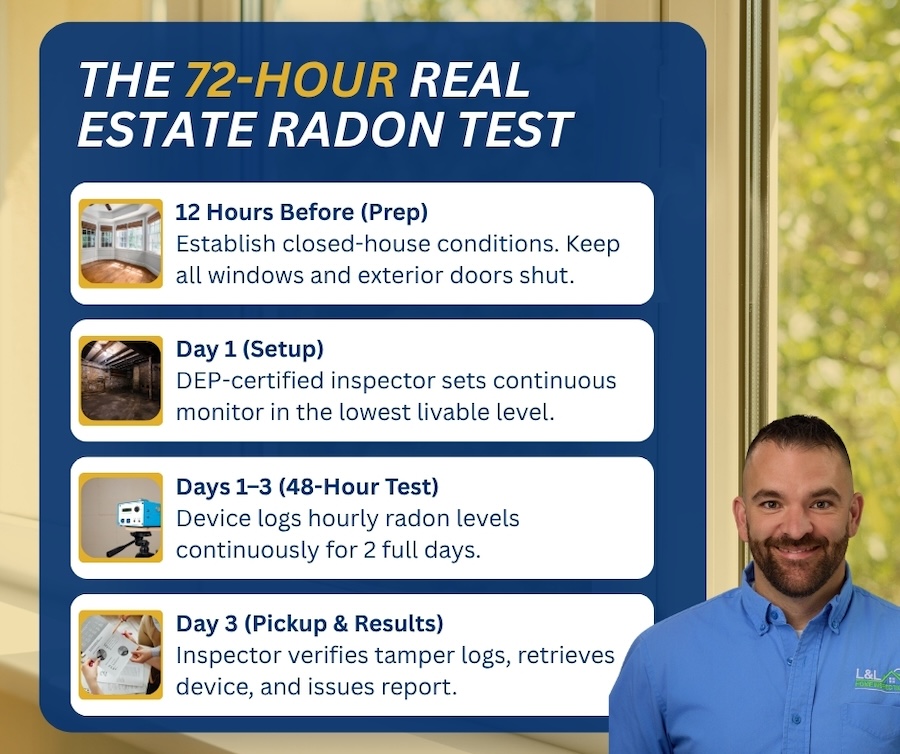
A real estate radon test usually takes about 3 days from start to finish. That includes 12 hours of prep, 48 hours of testing, and a short wait for the report. Here is how it works step by step.
- Closed-house conditions start (12 hours before). All windows and outside doors stay closed. Normal coming and going through doors is fine. The EPA says these conditions should begin at least 12 hours before a 2-to 4-day test and continue for the whole test.
- The inspector places the device. A certified tester sets the monitor in the lowest livable level of the home, such as a finished basement or first floor. The EPA recommends placing it at least 20 inches above the floor and away from drafts, heat, and moisture.
- The test runs for at least 48 hours. A continuous radon monitor records radon levels every hour. This gives a clear picture of how levels rise and fall over the two days.
- The inspector picks up the device. At pickup, the tester checks for signs that the device was moved or the house was opened up.
- You get the report. With a continuous monitor, the results are ready soon after pickup. Charcoal kits must be mailed to a lab, which adds days to the timeline.
For buyers, this timing fits inside most Pennsylvania inspection contingency windows.
Many buyers schedule radon testing on the same day as their home inspection, so the device can run while the rest of the house is being checked.
How Inspectors Protect the Test From Tampering
In a home sale, the buyer, seller, and agents all have a stake in the result. That is why real estate radon tests include extra checks.
The EPA suggests steps such as a signed non-interference agreement, tamper-proof seals, and devices that detect movement or power loss.
Many continuous monitors also log temperature and humidity, so a sudden change can flag an open window.
Why Pennsylvania Homes Need Radon Testing
Pennsylvania has some of the highest radon levels in the country.
According to the Pennsylvania Department of Environmental Protection, about 40% of homes tested in the state have radon levels above the EPA action level of 4 picocuries per liter (pCi/L).
Radon is a natural gas. It forms when uranium in soil and rock breaks down. It has no smell, color, or taste, so a test is the only way to know your level.
The gas moves up through the ground and slips into homes through foundation cracks, sump pits, and gaps around pipes.
Homes with basements or crawl spaces are common entry points, which is one reason crawl space moisture problems and soil gas often show up together.
Southeastern Pennsylvania has a famous place in radon history. In 1984, a worker at the Limerick nuclear power plant set off radiation alarms on his way into work.
The source was not the plant. It was radon in his own home, and the case led the nation to take home radon seriously.
Two neighbors on the same street can also get far different results. Soil, foundation type, and how a home is sealed all change radon levels.
The only way to know your number is to test your own home.
Pennsylvania Requires Certified Radon Testers
In Pennsylvania, anyone who places or retrieves a radon test device for someone else must be certified by the PA DEP under the Radon Certification Act.
This protects buyers and sellers from inaccurate or poorly run tests. Before you hire anyone, ask for their DEP certification number.
What Can Change How Long a Radon Test Takes?
Several things can stretch the timeline or force a retest. Knowing them ahead of time helps you avoid delays during a sale.
- Open windows or doors. Opening windows or doors invalidates the test and forces you to restart it
- Severe weather. The EPA advises against short-term testing during severe storms or high winds. Big swings in air pressure can push radon levels up or down.
- Power outages. A continuous monitor needs power. A long outage can create a gap in the data.
- Moved or covered devices. Moving the monitor or placing items on it can skew the readings.
- Lab shipping delays. Charcoal kits must reach the lab within a set window after the test ends, often within about 10 days. Late kits can give unreliable results.
- Season. Radon levels often run higher in colder months when homes stay closed, and heating systems pull air from the ground. This does not change the test length, but it can change the number.
What Your Radon Test Results Mean
Once you complete the test, your report will show your radon level in pCi/L. Here is how to read it.
- Below 2 pCi/L: Low risk. Retest every couple of years or after major renovations.
- 2 to 3.9 pCi/L: The EPA suggests you consider fixing your home, even though this is below the action level.
- 4 pCi/L or higher: The EPA recommends fixing your home with a radon mitigation system.
Standards can differ a bit from place to place, so it can help to compare acceptable radon levels by state.
For homeowners who are not selling, the EPA advises following up a high short-term result with either a long-term test or a second short-term test before making repairs.
In a real estate sale, buyers often use the 48-hour result to negotiate a mitigation system with the seller.
After installing a mitigation system, retest the home at least 24 hours after the system starts running. It confirms that the system is bringing levels down.
Related Questions to Explore
How long does a radon test take to get results?
With a continuous radon monitor, results are usually ready shortly after the 48-hour test ends. Charcoal kits take longer because they must be mailed to a lab. Plan on several days to two weeks for those. Our radon testing service includes a clear digital report.
How long does a radon test take for a home inspection?
Plan on about 3 days total. That covers 12 hours of closed-house conditions, a 48-hour test, and pickup. Most buyers book radon testing alongside their general home inspection so everything fits inside the contingency period.
Is a radon test required when buying a home in Pennsylvania?
No state law requires a radon test before a home sale in Pennsylvania. Still, sellers must disclose known radon test results, and many buyers choose to test given the state’s high radon levels. If a test is done, it must be done by a DEP-certified tester.
How long does a long-term radon test take?
A long-term radon test runs for more than 90 days and can last up to a year. It gives the best picture of your home’s average radon level across seasons. Homeowners often use long-term tests after a high short-term result or to track levels over time.
Is radon testing really necessary?
Yes, especially in Pennsylvania. Radon is the leading cause of lung cancer among nonsmokers, according to the EPA. You cannot see or smell it, and nearby homes can have much different levels. Testing is the only way to know. It also fits well into a yearly home maintenance inspection.
Can I do a radon test myself?
Yes. Homeowners can buy DIY charcoal kits for their own use. For a real estate transaction in Pennsylvania, though, the test must be placed and retrieved by a DEP-certified tester. A professional test also avoids common DIY mistakes, like placing the kit in the wrong spot or mailing it too late.
When to Call a Professional
Call a certified radon tester when you are buying or selling a home, when a DIY test shows 4 pCi/L or higher, or when you have finished a basement or made big changes to your foundation.
A professional is also the right call after a mitigation system goes in to confirm it is working.
A certified inspector brings a few things a DIY kit cannot:
- Accepted results for real estate deals. Buyers, sellers, and agents can trust a test done by a DEP-certified tester.
- Hour-by-hour data. A continuous monitor shows how levels change over the full 48 hours.
- Tamper checks. Pros know what to look for and how to flag a test that was disturbed.
- One visit for more than radon. If you are also worried about musty odors or damp areas, it can make sense to pair radon testing with a mold inspection.
L&L Home Inspections is owned by Don Nagle, an InterNACHI Certified Master Inspector and Marine Corps veteran. Our team serves the Greater Philadelphia area with scheduling seven days a week.
Conclusion
A radon test does not have to slow down your home purchase. Here is what to remember:
- A short-term radon test takes at least 48 hours, and a long-term test takes more than 90 days.
- A real estate radon test takes about 3 days from setup to report, with 12 hours of closed-house conditions first.
- About 40% of tested Pennsylvania homes are above 4 pCi/L, so testing is a smart step for every buyer.
Need a radon test for a home sale or your own home? Get a quote for your radon test with L&L Home Inspections or contact our team with any questions.
